Turkish Tales: Our First Meals

Food plays an incredible role in any special event in our lives. So no wonder, our first meal in our new home is significant to us,  and kind of represents a big step in settling in.

Whats on the menu you ask? Something exotic like local specialties of kofte or borek? Perhaps a home classic like chicken? Well bearing in mind I’m still stocking up my kitchen and groceries are not as straightforward as back home (not everything in the supermarket is translated for starters) and I was exhausted from the trip over, the menu was simple but just right to hit the right notes Alhamdulillah!

Mum’s Grub Rules

For our very first dinner that we ate at home, we were lucky to have some homemade mum’s grub from South Africa.

Nothing like urad dhall, mealie meal rotis and spicy carrot pickle to comfort and pick you up!
I also fried some okra (“bhinda”) as its available in abundance here- the only real ‘indian’ vegetable really.

And we had extra food leftover for hubby to take to work for lunch – he was quite the envy of the office, and didn’t mind a bit sitting in the canteen with his roti and dhall! We ended up packing some carrot pickle for his friends who missed home food too so it was great to share the love.

End result

For the first dinner that I cooked, I braved it with a new kind of fish called “plaithe” which turned out to be tasty and not too “fishy”. I served it with spinach and onion (seasoned with “pulbiber”- a Turkish favourite which is red pepper flakes) and fresh potato salad.

When cooking for the first time in a new kitchen, and country really you have to be careful before you commit to preparing any dish – as you cannot take for granted that you have everything you need- even seemingly simple things like garlic, or chillies may not be as readily available. So I made good use of my personal favourite “Amina’s wonder spice peri-peri marinade” from South Africa for the fish, as I know it wouldn’t need anything further to flavour the fish – just pour over and you are ready to fry!

Get your first meals in your new country right, and you are on to the right track I say. May Allah grant us more barakah, Aameen
Next stop : cooking some chicken – but first I need to figure out how to make my own ginger/garlic paste (not found here!!)

Finding our way Insha Allah,
M4Life

Turkish Tales : The Move

Seven years ago I found myself blogging about my experience moving abroad to the UK from South Africa. I shared some of the challenges with our new place, work and the weather. This month I moved to Istanbul, Turkey, just on the other end of Europe!

When my hubby and I emigrated to England, UK, we did so after never visiting the place. We just went with our entire flat of belongings, some saved cash , new jobs and a firm determination that this was what we wanted for our future. We did have many chats with family and friends before that of course, weighing pros and cons of other countries, and for us UK came out tops.

I laugh when I look back at that move, because it the naiviety we had was totally overshadowed
by all the enthusiasm and excitement of new prospects. We did find the move challenging at first and now I realise it was because we were not totally prepared to face the new lifestyle, setup and culture of the new country. It wasnt because we didn’t try to prepare…nor that people living there didn’t help us with tips and pointers – but it was because we really didn’t know what were the best questions to ask that would equip us best to settle in our new abode!

Some of the drastic new lifestyle changes that took us time to adjust to in the UK (because we didnt know to ask about!) included:
– the small, compact size of houses, especially compared to our spacious living in South Africa
– the distance between places, how to best prepare for long commutes
– how best to tog up for bittery cold winters and the snow that comes with it

We moved to Istanbul after visiting it for one day and one night, en route to another destination but doubt that helped much! This time though we feel a little more wiser and more grown up Alhamdulillah, in that we knew to ask pertinent questions that would inform our choices about what to take and what to look out for to better manage our expectations.

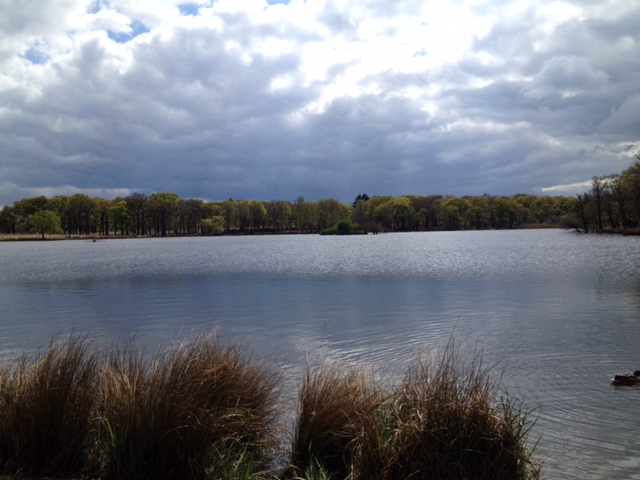
We started our relocation project by taking my hubbys Turkish colleague out for lunch and a walk in Richmond park to quiz her on topics ranging from “What are the houses like in Istanbul?”, “What essential items should we remember to pack?” , “What do people do at the weekend?”. This enabled us to have a much more informed idea when preparing to move and researching accommodation options Alhamdulillah.

    Lunch in the beautiful Richmond Park, a Royal Park

Though even after all that preparation, you only really know a place till you live there! Everything else is theory and hearsay – useful to have in mind but just know that the reality only kicks in when you get there – so my lesson is not to expect to know much – anything really – till you take that one way flight over and start living!

Stay tuned for more on my tales from Turkey Insha Allah.

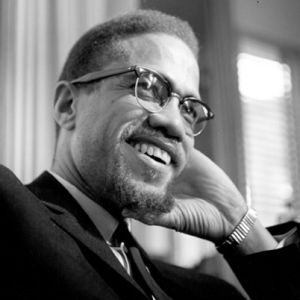
8 lessons from life of Malcolm X that could change your world

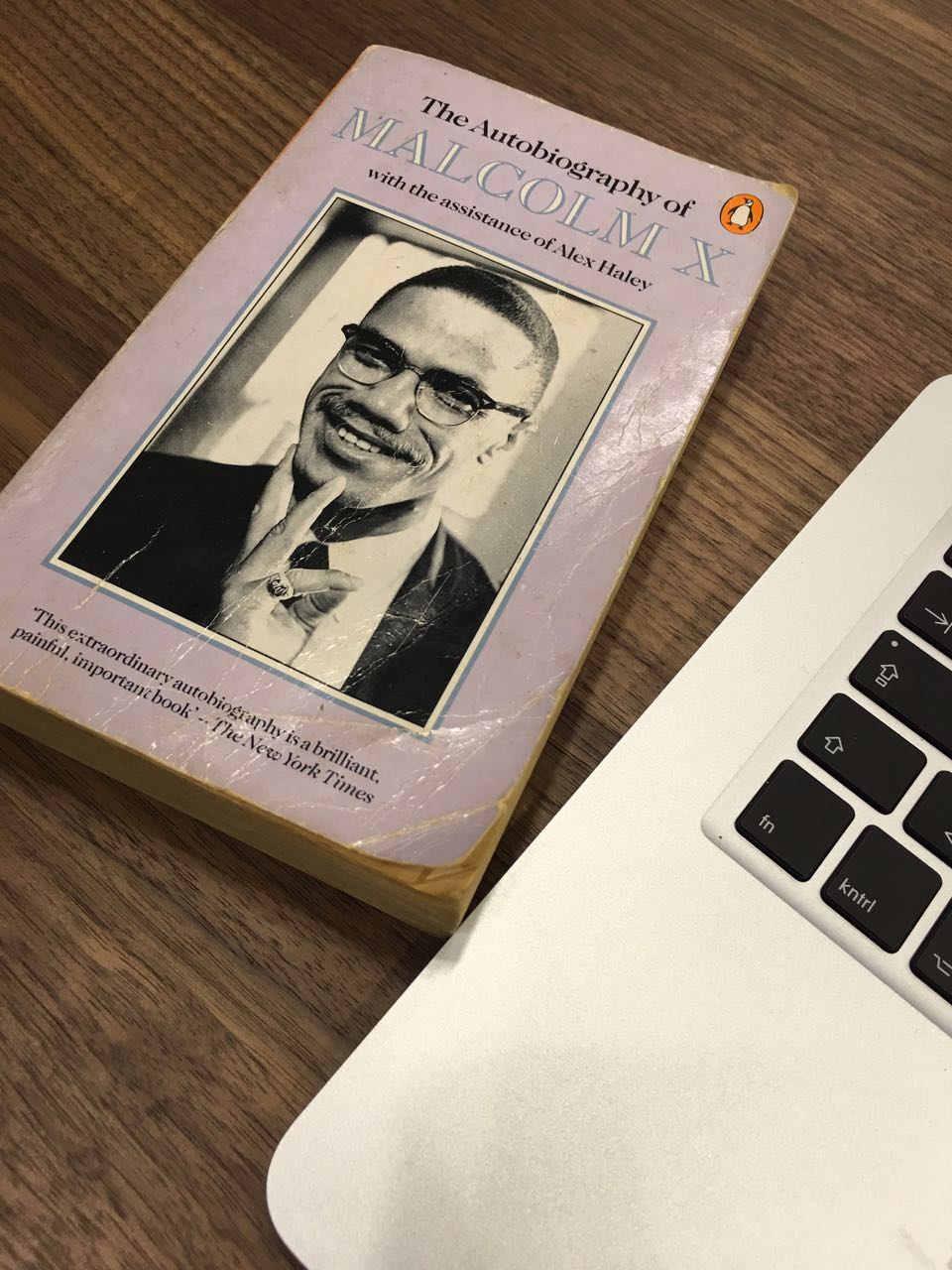
When I was 13 and in High School I had to do a speech on a well known figure. I came across a flyer at home on Malik el Shabazz (Malcolm X), and decided to do my speech on him. I was too young to fully appreciate the remarkable character and amazing story of Malcolm X. So 20 years later, (slightly!) more mature and having the opportunity to read the entire “Autobiography of Malcolm X” by Alex Healey, I’d like to share my remarkable experience in learning and understanding about this amazing individual that have had a huge impact on my worldview.
· 


    These are some of the lessons that I took out from his story:

How we can use the remarkable characteristics of our brotherhood and unity as Muslims to creative a positive impression of Islam to the world.

Malcolm X was completely taken aback during his journey of Hajj (Muslim pilgrimage to Makkah) when for the first time he experienced equality and unity with people where race was not a criterion. He never knew that this was a possible. He spoke about how people of all colours and backgrounds welcomed you, ate together and spoke to you with respect. He called it “colour blindness of the Muslim world.” I love that phrase. He came from a background where race was the most dominant concept in his life – He said: “It’s what all black people were focused on either defending it, or fighting against white people about it, or bringing themselves down because of it.” But when he got to Makkah, he saw how the focus of everyone was on worshipping Allah, and the question of race was insignificant and irrelevant. This was a remarkable shift for him. He said that he could see how all Muslims in that special place behaved as “one” and how this was a reflection of the “Oneness of Allah.” This unity was the reason for Malcolm’s complete shift in perspective regarding the “white man”, which he later captured in a letter he sent back home. One of his other observations was the remarkable opportunity that this brotherhood could serve for really communicating to the world what Islam was about. He said:
I saw that Islam’s conversions around the world could double and triple if the colorfulness and the true spiritualness of the Hajj pilgrimage were properly advertised and communicated to the outside world.
This I made me realise that only a Muslim can understand the sense of brotherhood we feel during Hajj (as only Muslims are allowed to enter the boundaries of Makkah and participate in Hajj). We therefore have a responsibility to “market” this to those who have not experienced it i.e. strategically increase awareness and inspire others to also share in this wonderful gift. Perhaps we could use the hashtag #muslimunity to share examples of our unity as Muslims, from the way we interact with our neighbours in our day to day lives to the practices of Eid and other such occasions. I feel if we did this, then we could fulfil one of Malcolm X’s visionary initiatives that he didn’t get a chance to execute given his short life. We can help build this up so it becomes a beacon of representing one of the most brilliant aspects of being a Muslim- our unity and sense of brotherhood.
·  Everything happens for a reason, through Allah’s Wisdom
Malcolm X’s life was completely transformed when he was off the streets and in a complete change of environment. He discovered Allah, Islam and new way of life from within a prison cell. But for this to happen, he had to drop to his lowest point, after much grief and corruption, to finally being locked up in jail. One could view this as a terrible situation to be in – however it represented a complete turnaround for him, and reflects the Power of Allah to guide whomsoever He desires.
·  The racism that was prevalent in America, in such recent times as recent as the 1950’s was a total eye opener for me. I always knew it was there, but then something struck me about one particular incident – where Malcolm X describes how black people had to sit in the back of a bus and the white people in the front. That really stood out for me – how absolutely insanely ridiculous it is for one man to determine that another human being is not worthy of sitting somewhere because the colour of his skin? I find these questions roaring in my head: What kind of people do you have to be to allow this to occur? It’s the same as in South Africa during the days of apartheid, where there were specific benches for black people to sit on and different for white people. Where do you get off deciding one kind of people are superior to another? I find it totally appalling. And the plight of the people facing this oppression really touched on something in my heart.
·      He was incredibly insightful in how he approached people to spread the word.
    He knew that to connect with people, he had to meet them where they were – on their level, and in their way. So when he started to spread the word of Islam, he first understood where his audience were and used angles appropriate to them to ensure his message landed optimally. Similarly, one of the remarkable programmes of the Nation of Islam (the religious movement that brought Malcolm X into Islam led by Elijah Muhammad at the time) for treating dope-addiction had six steps for addicts to follow, the last one being once you were over your addiction, you would then have to go out and ‘fish in’ others as you know what it was like and can approach others with knowledge and technique that they would better respond to. Because of its tremendous success and effectiveness, this programme was covered in the New York times, and other groups were interested in using this unique approach.
·  How to connect and positively influence a crowd
One of Malcolm X’s  strength’s was that he was incredibly eloquent and had a commanding way of engaging a crowd as well as the ability to debate with power. In the book, he spoke about his ability to “feel the audience reaction” and this being his unique trump card. His approach resonates with me as I am reminded about one of the concepts of BodyTalk (a whole-healthcare system I practice) around synergistically using both aspects of your brain to function optimally– Malcolm X used his left brain for the logic, structure of his argument and learned facts and the right brain to intuitively feel his audience and then appropriately act, displaying an amazing ability to fully engage with people to bring out the best results – something we can learn from and practice too.
·  He makes an interesting point about how society can be lifted if we strike a balance between “material progression and spiritual values”. I love that. It’s not saying that we shouldn’t increase our wealth and the things we own necessarily – but he suggests that if we do, we do not loose the spiritual side – meaning not attaching yourself to the wealth. Rather, use it as a means to benefit society as well, not just for selfish gain. These are the principles taught in Islam.
·  He was not afraid to change his point of view and openly share this. That in and of itself takes immense courage. Most of us think it’s a sign of weakness if we change our viewpoint on something we perhaps held very strongly before. But life is dynamic, things can evolve and to having the strength of character to openly admit to having a new perspective is refreshing and really admirable. Malcolm does this when his perspective of white people changes after Hajj. He also has a huge realisation of how he had held Elijah Muhammad in such a high rank, such that he felt he was even divinely – and so when Elijah’s human weakness was revealed (he was involved in adultery, and Malcolm X suspected he played a role in encouraging the death sentence for himself), it was crushing for the former, but also hugely insightful. It made Malcolm X realise how it is dangerous to put your faith in a human, for only Allah can be solely relied on and only Allah is Most Powerful.
·  The influence of media. I think it was really horrible how Malcom X’s actions were negatively portrayed in the media. Of course he must have been seen as a threat – inciting so much change and getting his people to challenge their situation and giving them the courage to stand up for their rights. He was portrayed as a “hater” and “igniter of violence” and this tarnished his reputation and hindered his cause. There was also the jealousy amongst his own people that led to them to trying to destroy him, ultimately leading to his assassination
Allah truly guided him, as he was a man that came from the extremes of on one hand having a background as a drug addict and street hustler and then found Islam -at least a version of it until his mind was completely open to the true Islam and worshipping Allah as He should be worshipped.
Because he kept seeking the truth as his main drive in life, this enabled him to keep an open mind despite his immensely strong convictions to the Nation of Islam and Elijah Muhammad. And that’s why during Hajj he was able to finally completely transform and see what Islam was really about. He was guided to see that what he was taught by Elijah Muhammad about the “white man being the devil” was not true, that Islam taught equality and unity and that through having a higher purpose of serving Allah, racism was erased.
In his famous “Letter from Mecca” he said:
“America needs to understand Islam, because this is the one religion that erases from its society the race problem. Throughout my travels in the Muslim world, I have met, talked to, and even eaten with people who in America would have been considered ‘white’–but the ‘white’ attitude was removed from their minds by the religion of Islam. I have never before seen sincere and true brotherhood practiced by all colors together, irrespective of their color.”
The full letter can be read here it makes for a fascinating read: http://www.malcolm-x.org/docs/let_mecca.htm
He was a remarkable man, a visionary and a leader. He was impatient, an activist and he wanted to see change. He was dedicated and passionate, he wanted to grow the number of Muslims in the world and he was prepared to go out and do what it takes himself to achieve this.

The world could do with people like him today.

Ramadan in the Workplace

Salaams

We’re in the swing of things this Ramadan, hopefully reaping the benefits of this blessed month as best we can!

This year I am not working at the office (I see my BodyTalk clients periodically at the clinic or at home via distance sessions). However I do recall my many years in corporate, fasting through the endless meetings, trying to not get distracted with the recipe emails sent to my Inbox and enjoying the occasional early afternoon nap in my car or in the First aid room!

I was fortunate to have colleagues and managers who were very understanding. That’s part of the culture of Unilever I guess. I was able to adjust my (already quite flexible) schedule so I could leave a bit early, as especially in the UK with the long hours of fasting, you need some rest in the evening.

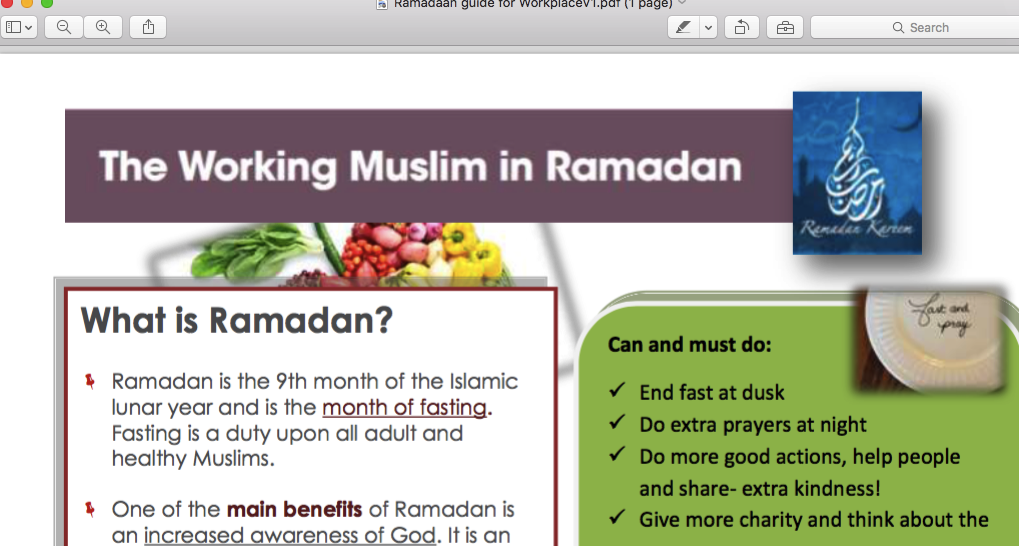
One thing that helped me to set things up with my colleagues was to explain upfront about our fasting month of Ramadan. I created this One Pager “Ramadan in the Workplace Guide” that was a handy guide to share with my team to explain Ramadan and Eid in a simple way. I wanted them to appreciate how significant this month was for us, so in some way they too were sharing in this special time, just by being aware.

Handy One Page PDF
Handy One Page PDF

I know we are already in the midst of Ramadaan, but if you would like to share something simple with your colleagues at work then feel free to download this PDF. It does have some specific reference to Europe, but can serve as something useful, Insha Allah.

All the best for the rest of Ramadan, and do remember me in your prayers!

Radiating through Ramadan,
M4Life

Ramadaan: the month of sharing!

Assalaamu alaykum

One of my favourite parts of Ramadaan is the sense of sharing and unity that is naturally felt during this month. I think it’s because most of us are aware of the immense rewards offered for feeding a fasting person and we all want to cash in to benefit!

This is captured in this beautiful Hadith:

It was narrated that Zayd ibn Khaalid al-Juhani said: The Messenger of Allaah (peace and blessings of Allaah be upon him) said: “Whoever gives iftaar to one who is fasting will have a reward like his, without that detracting from the reward of the fasting person in the slightest.”  Narrated by al-Tirmidhi, 807; Ibn Maajah, 1746.  

I also think there is such a delightful feeling when you see people after a long day, tired and a bit hungry feel ease and satisfaction when they break their fast and enjoy something you have prepared for them. I love cooking so seeing people enjoy something I made like perhaps a new dish, or bought like maybe some fresh fruit I saw in the supermarket brings me immense joy.

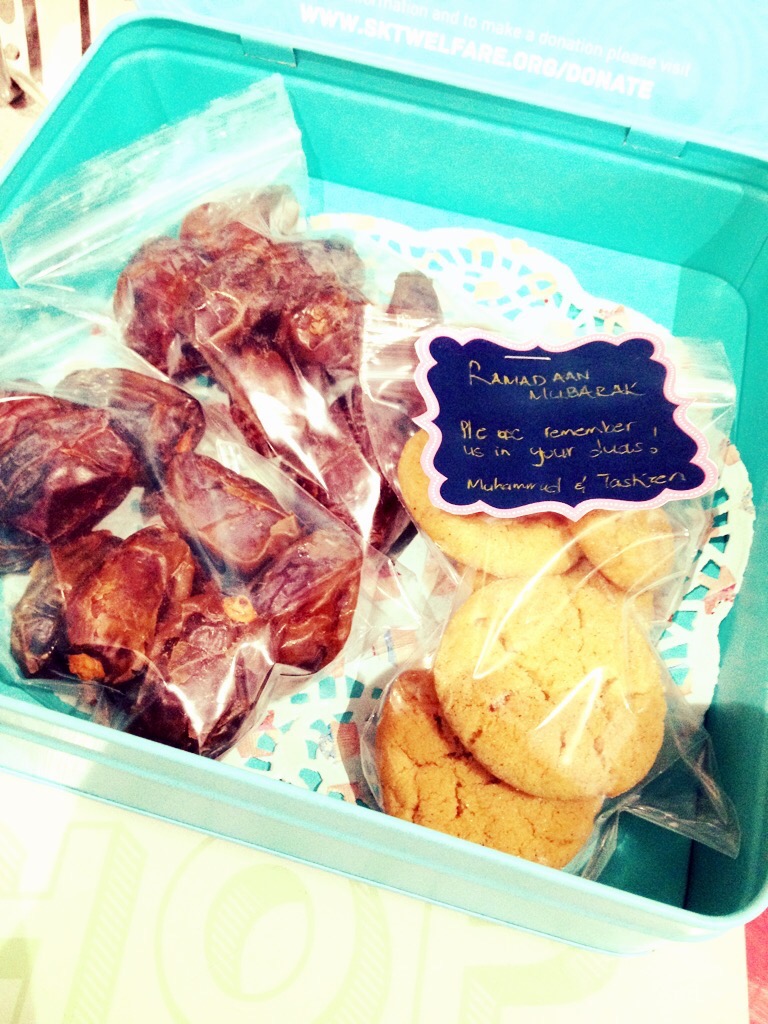
This year I am in the middle of a house move so inviting people over to share iftaar will be a bit challenging. However, I tried to take advantage before Ramadaan to share what I could with my family and friends. I made these little Ramadaan packs with dates and cookies (smackerdoodles – a sugar cookie) and distributed to my neighbour and my family.

I was thrilled with this charity initiative from SKT Welfare where you can purchase beautiful tins with a kg of dates and the proceeds of each tin gives a family in Syria 50 loaves of bread. I made smaller parcels of the dates and gave that with the cookies. The tin is high quality and available in smart colours and makes for a really neat way to store your dates in style!
The offer is still open and the details are here : http://dates4syria.com/.

I hope I can find more ways this month to share and build our sense of unity that we so fortunately enjoy as Muslims Insha Allah.

#muslimunity #muslimbrotherhood #muslimsharing #sharingramadanwithneighbours

Sharing and caring,
M4Life

Simple moments from Umrah that I wish I could have again


Slms

Returning from Umrah, knowing it may be a long time before I can go back again is heavy on the heart. As I return to my regular life I find myself dreaming in the day as memories of simple moments there float into my mind. Right now, standing in my kitchen preparing dinner , I wish I could …

– Just pop out to make a Salaah in the haram.

– fill my bottle of water with Zam Zam without restriction.

– get a glance at the Kaabah

– listen to the nasheeds about Makkah and madinah without my heart breaking and without crying

Just jump on the next plane and go back!!

Insha Allah may Allah take us all there one day, Aameen

Keeping the faith,
M4Life

Umrah in my 30's vs 20's

IMG_1357
Salaams!

I’m just back from being called again to the blessed lands of Makkah and Madinah to make Umrah with my family, Alhamdulillah!

I previously made Hajj about 8 years ago. That was my first pilgrimage and only my second trip overseas. It was an amazing experience, one that definitely lasts a lifetime- both the five days of hajj itself as well as the Umrah and visit to Madinah that accompanies it.

I’m calling this post umrah in my 30’s vs 20’s, to refer to the contrast between the two trips I have had to visit Makkah and Madinah, but I’m not entirely sure what is behind the differences I felt between the previous visit and this one , but whatever it was , I found an interesting contrast that’s worth thinking over.

The first difference was that on this trip I felt more connected with other hajjis ( other people performing umrah). My first trip was during the time of hajj so the crowds were intense – and it was challenging for me; my test I called it. As a result I think I resisted the crowds and tried to stay away ( which is impossible of course as they are everywhere !)
But this time, Subhanallah I was open and more relaxed with people around me. As a result my experience was richer and more meaningful. I relished in giving out sweets and gifts, handing out Zam Zam and speaking to people from Palestine, Turkey, Pakistan, Egypt. These were small efforts, and I wish I could have done more but evry moment that I spent interacting I really enjoyed. This time, I embraced the crowds, worked alongside rather than against them and Alhamdulillah this was so fulfilling. May Allah accept.

Second difference : finding quiet time to pray, think and even plan! Yip, in Madinah, I found myself so clear in my mind it was wonderful. I used to find it noisy and busy on my first trip, I think I let everything around me get to me! This time I relaxed in my environment and tried to find my own space to do my thing, which was amazing. I could spend lots of time praying this way. I felt peaceful, satisfied and it was a very fulfilling experience. Rest and having meals felt more enjoyable as well as it came after spending a long time praying in the haram.

I also noticed that on my previous trip I followed my books strictly, not wanting to miss a single recommended dua even if it meant navigating crowds in tawaf with my faithful books in my hand. I feel that now, a bit older (and wiser?), I paid more attention to closely guarding the duas from sunnah of course, but that I found my own duas and zikr to make at significant times, that resonated with me at the time. In this way, I was more engaged and made the tawaf for instance more meaningful- and personal. 

It’s not that one way was better than the other, it’s just some observations that have stood out for me as being interesting and worth sharing.

Lastly, the highlight of my first trip was the five days of hajj for sure – I loved camping in the tents of Minah, sleeping under the stars in Muzdalifa and making friends for life during those special days.

The highlight of my second umrah this year was climbing up Jabl al Nur to reach the Cave of Hira.
But you’ll have to wait to read my next post for more on that exhilarating experience!

May Allah accept, forgive my shortcomings and take us all on this marvellous journey!IMG_1362

Aameen
M4Life

"Do I prioritise connecting with Allah(SWT) over everything in my life?"


​Stop Lying to Yourself about what matters!

I listened to an interesting talk last night by Mirza Yawar Baig (“Fajr Reminders” which covered the topic of time management. More specifically, how we make time for physical, emotional, spiritual and social aspects of our lives.  If we have to prioritise activities for each of these every day, which one would automatically be number one?  As Muslims, obviously, we answer spiritual should be first but how often is that really true. Do our words really transform into action?


‘For me, I have set myself a goal to complete some online quraan tafseer.  Yet, I still find myself putting it off for the last few days. 

So I have to ask myself, am I really treating the spiritual dimension in my life as a priority?

Ironically, although we give less priority to this spiritual aspect, it is the one thing that will help us achieve all other aspects.  For example taking time to start the day with Quran recitation may feel like it’s delaying you from starting your tasks for the day but actually that time will give you so much more barakah – in your time, mindset, abilities, etc.

When we talk about the spiritual dimension, we might think its all up in the air and not very tangible. But what it really is, is our connection with Allah (SWT).  So now ask yourself – “Do I prioritise connecting with Allah(SWT) over everything in my life?”

In order to keep ourselves on the straight path we need to be, first and foremost, honest with ourselves as to where we are right now with regards to our connection with Allah (SWT) and what we are going to do to improve that connection.

Polishing the priorities, Inshallah
M4Life

Two Forms of Mercy…Two states in One

Salaams

So I listened to a talk recently by Ustaadh NAK (you know who I mean!) explaining the two Names of Allah Ar Rahman and Ar Rahim : two forms of mercy and I was so inspired. 

I also learnt that by listening to something more than once it really solidifies your understanding. Anyway here is my take on it based on what I heard:

Ar Rahman – ارحمان : Allah’s mercy and love is extreme, not permanent( this life),  happening right now ( eg hunger similar word pattern جوعان)  mercy that’s more immediate.

Ar Rahim – ارحيم – Allah’s mercy  that’s always there and you can count on it. Quality that doesn’t change. Not necessarily taking place right now- potential.

So what does it mean?

When you want Allah’s mercy in a time of need, you need it immediately – and intensely! Then you appeal to His quality of Ar Rahman. Not thinking of the future or the potential of mercy right now. But as a human we need instant meeting of needs.

Once it’s met, you now can turn to his quality of Ar Raheem knowing he will always have Mercy should you need to call upon it in the future.
Subhanallah!

Only in Allah the Most Powerful can two forms exist in one – amazing.

May Allah grant us understanding and MERCY

Aameen

🙂
Praying for His Mercy,
M4Life

When wearing your hijab is like wearing your knickers and socks….

Slms,

I’m sure you want to know what is going on with my title, so I’m going to share a story with you that explains where this phrase comes from!

I was chatting to my friend who recently Alhamdulillah decided to start wearing hijab. I’m so proud of her. She works in corporate and travels significantly so I’m sure its a quite a challenge and so I’m so pleased for her and make dua Allah makes it easy for her, and rewards her for sincerity in trying to please Him.

So she was saying how its tricky at work…people seem to be looking at her weirdly…and shes so aware of it all. As a regular hijabi myself, also in corporate for about 10 years, travelling in Europe and working with multinationals from Australia to Brazil,  Alhamdulillah, this is the advice I gave to her which I hope makes sense to you and inspires you to either consider starting to wear hijab or if you are, to continue and NEVER take it off…for as I say “Keep at it till wearing your hijab is like wearing your knickers and socks!”

  • Don’t send out “uncomfy” (sic) vibes : Don’t be overly conscious of wearing hijab as you will no doubt send out signals to others if you are feeling uncomfortable. This will make you feel more out of place for no reason as in reality most people wont even notice anything!
  • Take the First Step Forward : I received feedback once on a leadership course (in a very honesty sharing session!) that people wonder whether how to approach hijabis – as in will you talk to men, how will you respond etc. So as a hijabi in the workplace, perhaps we need to take the first step to talk to people, show our personality and that its OK, we don’t bite or scare, just regular people also interested in shopping and makeup (in a halal way of course!).
  • Show them you’re Still the Same : If you have recently started to wear hijab, just continue as normal showing them you haven’t changed who you are, talk the way you would and do your thing. Their main concern would be whether they need to be in any other way with you so just keep being as you are and things will fall into place naturally Inshallah.
Keep at it sisters, you know you have turned the corner when you cannot leave the house without it on, and when wearing your hijab is like wearing your knickers and socks – you can never forget it and cant do without it!! 
May Allah make it easy for us all.
Me at my previous workplace 🙂
Do you have any other tips to share with other hijabi muslimahs? I have so many stories to share about my hijab adventures, Inshallah with other posts to come! 
M4Life