Teaching Toddlers: Bismillah

Bismillah Activity 
For playgroup in Week 2, we focussed on the theme Bismillah: 
“In the Name of Allah”

For Moms: By saying this before we begin anything, it is a  way of remembering and thanking Allah. It is a practical way of making us more mindful of Allah. When we get into this routine, then we remember Allah and always try to do things that please Him. We get maximum benefits from whatever task we are doing by remembering to take Allah’s name before it.
Aishah [R] related that the Messenger of Allah (ﷺ) said: “When one of you eats food, then let him say: ‘Bismillah.’ If he forgets in the beginning, then let him say: ‘Bismillah Fi Awwalihi Wa Akhirih (In the Name of Allah in its beginning and its end.)” [Jami` at-Tirmidhi 1858] A simple act, such as eating becomes a source of blessing (by the permission of Allah) and an act of worship. 
Additionally, various Hadith and saying from Prophet Muhammad (PBUH) show us that saying this phrase enables us to gain Allah’s blessings.
So how do we teach this to kids:

We always begin our playgroup with Salaam song( Omar Hannah) and “Nabil & Noura say salaam” each week to build consistency.
Related to the topic this week, we chose these concepts:
Song: Bismillah song by Dawud Wharnsby Ali (lyrics here). It’s a really simple song so ideal for toddlers.
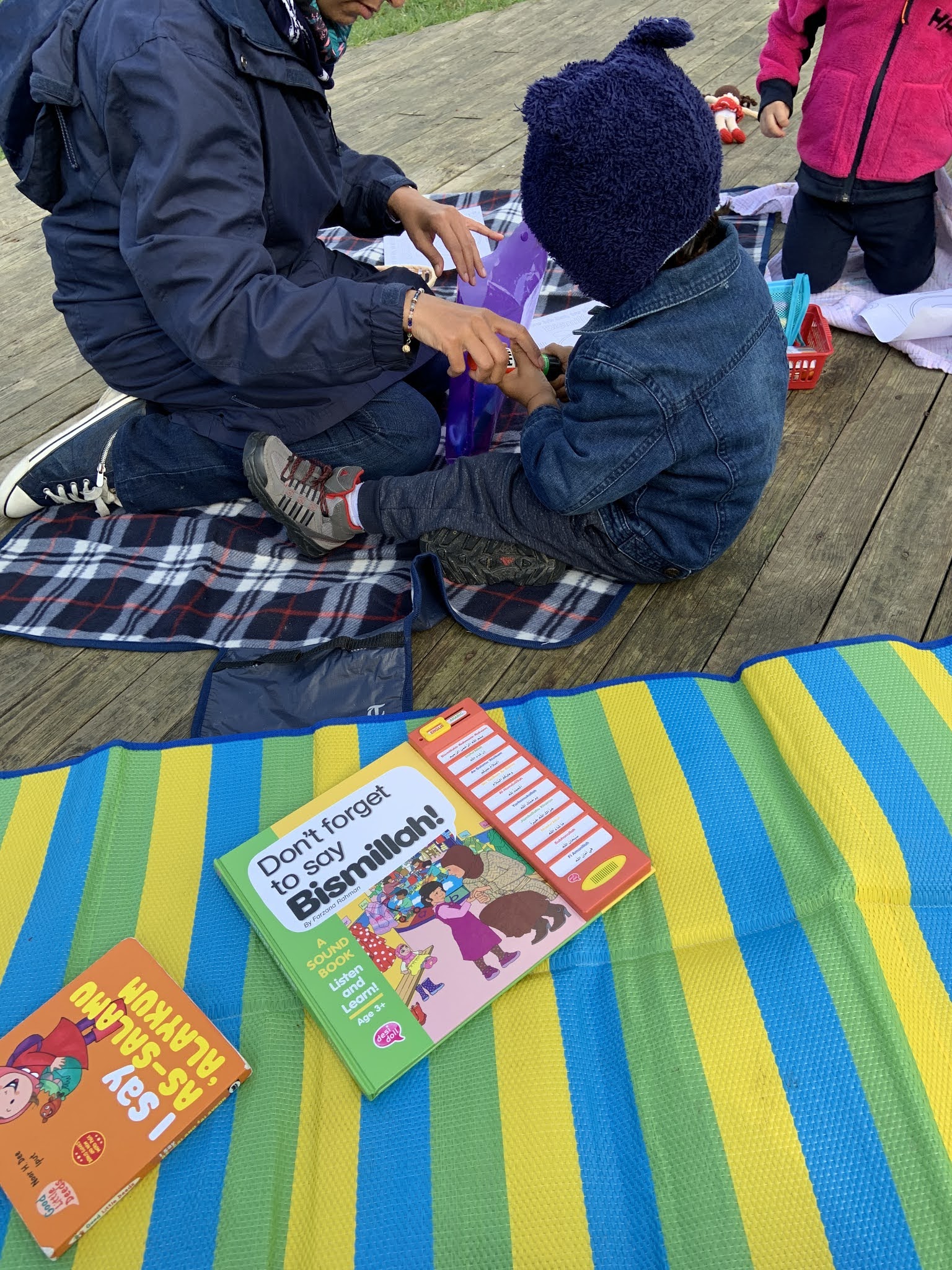
Book : “Don’t forget to say Bismillah” with sounds from Desi Doll Company. It’s interactive so kids enjoyed pressing the buttons to hear the sayings in English and Arabic. Highly recommend.
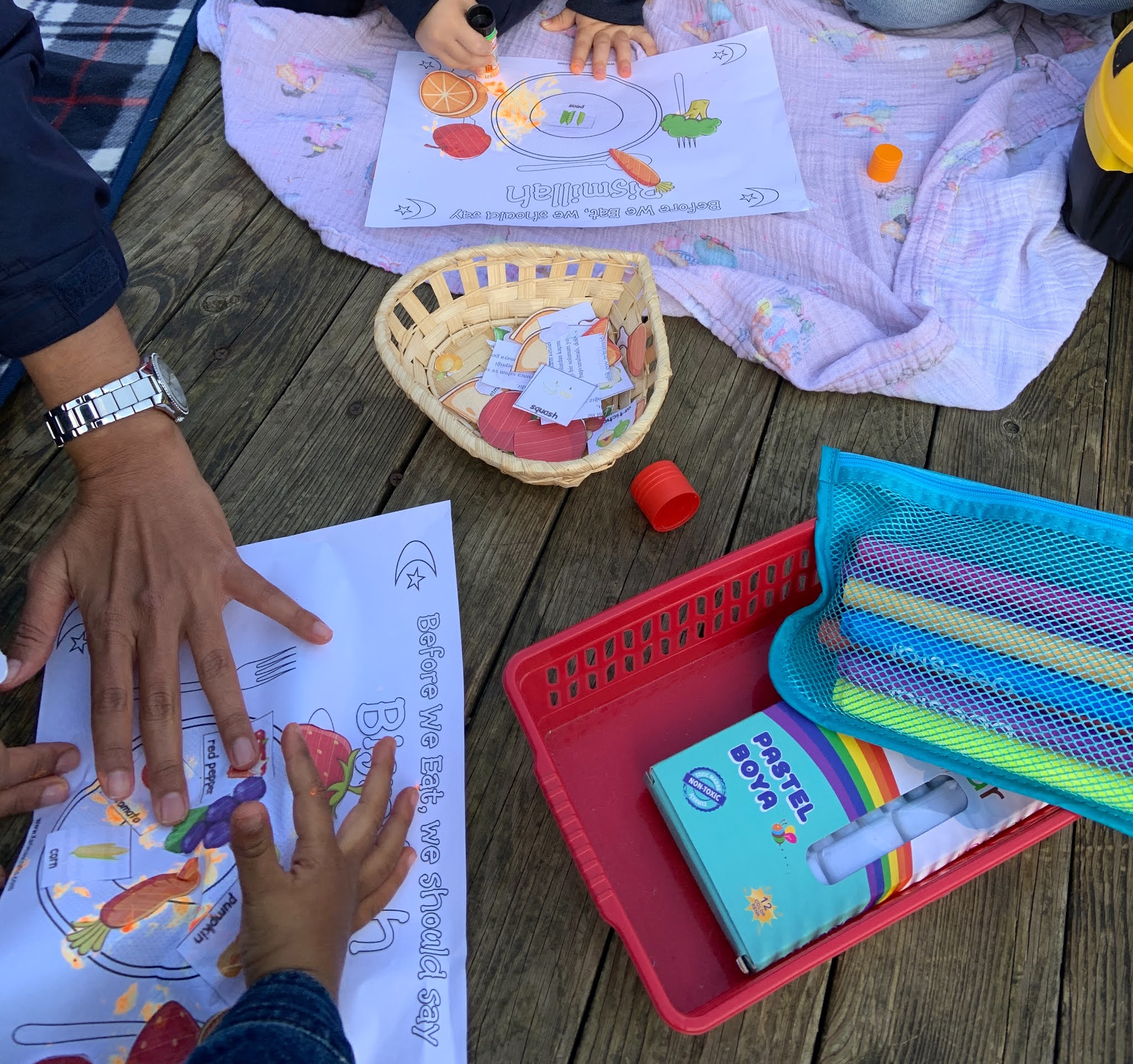
Activity : Create your own Bismillah placemat – sticking fruits and food for fine motor skills.
I cut out colourful fruits and these placemats from Karima Krafts.  (Ps we’re outdoors in the park hence the setting in the pics below!)
                                       
We always end with a snack and for sunnah snack I offered dates and cucumber. Our beloved Prophet Muhammad (May peace be upon him) combined cucumbers with ripe dates saying: “the heat of the latter is reduced by the coolness of the former.” (Bukhari, Muslim, Abu Dawood and Ibn Majah).
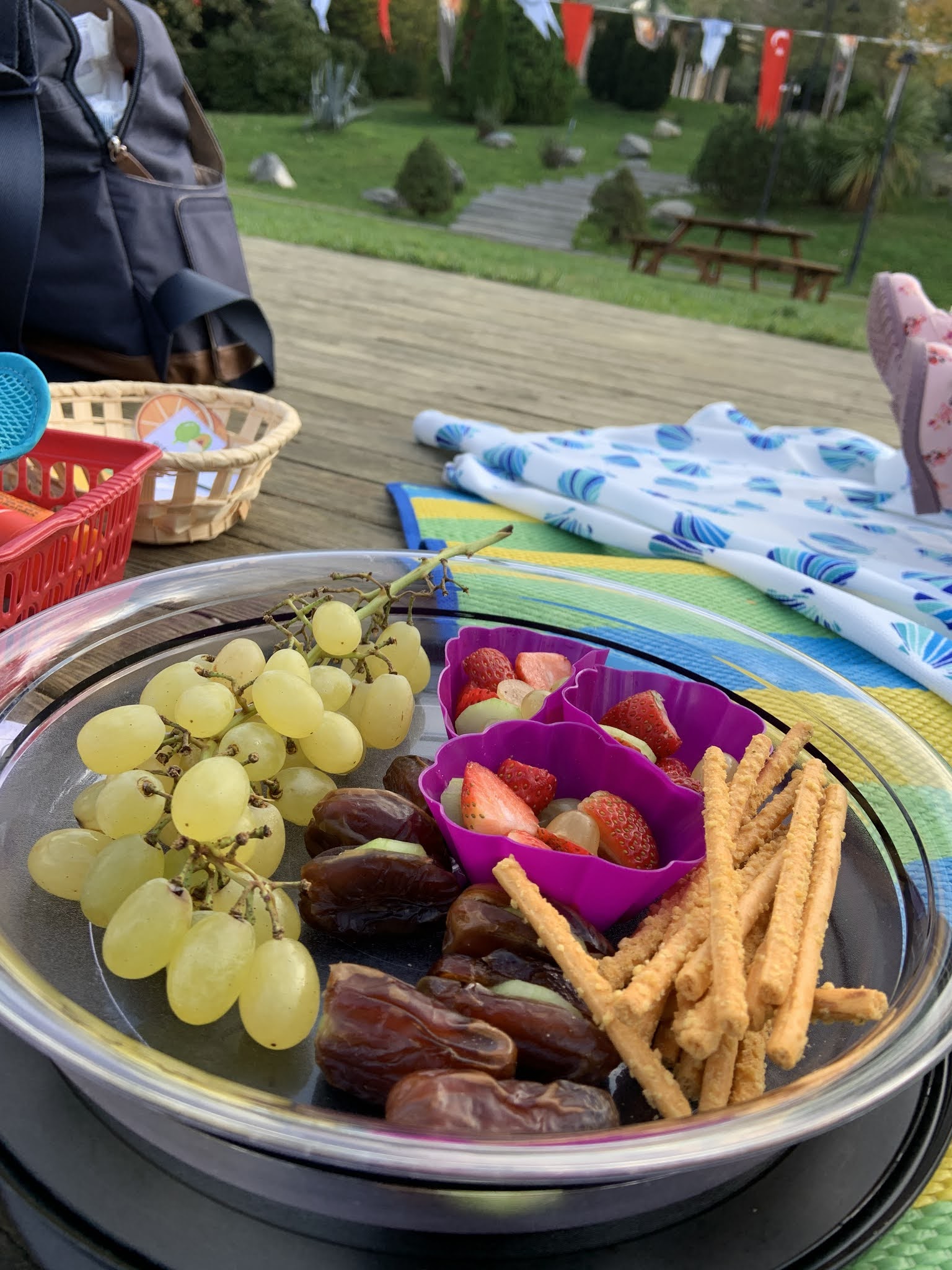
We also had fresh fruit and crackers to keep the young ones going!
This is a great beginner activity but of course the main learning comes from daily practice – so remembering to say bismillah when beginning to eat, changing clothes, putting on shoes, leaving the house – and every little or big action.

How will you teach “Bismillah” to your little ones today?

How I improved my duas to Allah with one easy tool

As part of my preparations for Ramadan this year, I decided to spend some time focusing on my dua, and defining what it is I would be asking of Allah during this special month. I realized that whilst dua is a daily practice, preceded by my every salaah, I have not given it enough meaningful attention to benefit from the value I could otherwise gain from it.

Allah says in the Quran (Chapter 40, Verse 60): “Call upon me; I will respond to you.”

I became aware that I have not been clear and specific in my appeal to Allah, often just quickly rattling off some previously thought of requests without giving it conscious thought. To expect results, I need to define exactly what I wanted from Allah, in all aspects of my life. This way I can feel sincerer and connected to Allah with my requests. So I sat down and brainstormed all the many things I wanted for myself- and my family by using an awesome tool called “Mind Maps.”
Artist: AJacub786
This takes me back to my school and university days where I would use this technique for studying, to categorise information when there is a lot to work with. Mind Maps are a creative way to visually represent ideas or lists that we have in our minds. It can help us to structure our thinking to give it purpose and meaning. We start with one idea and branch off to many others, thereby capturing all the things we want under each topic.

How to complete the Dua Mind Map
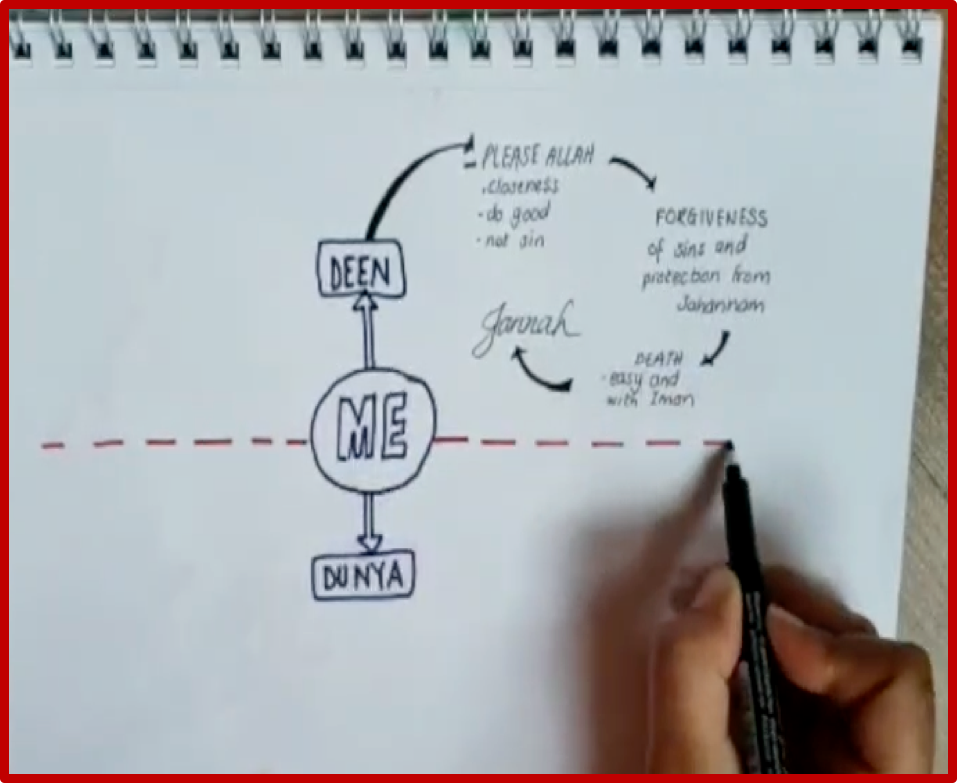
So for example, when structuring my dua request, I started with myself: “Me” in the image above, and then separated into two main areas: Deen (Hereafter) and Dunya (This World). Under “deen” I listed a few headings such as pleasing Allah, forgiveness and our ultimate goal – attaining jannah. You could list all the steps we need to take to get to jannah.


This World
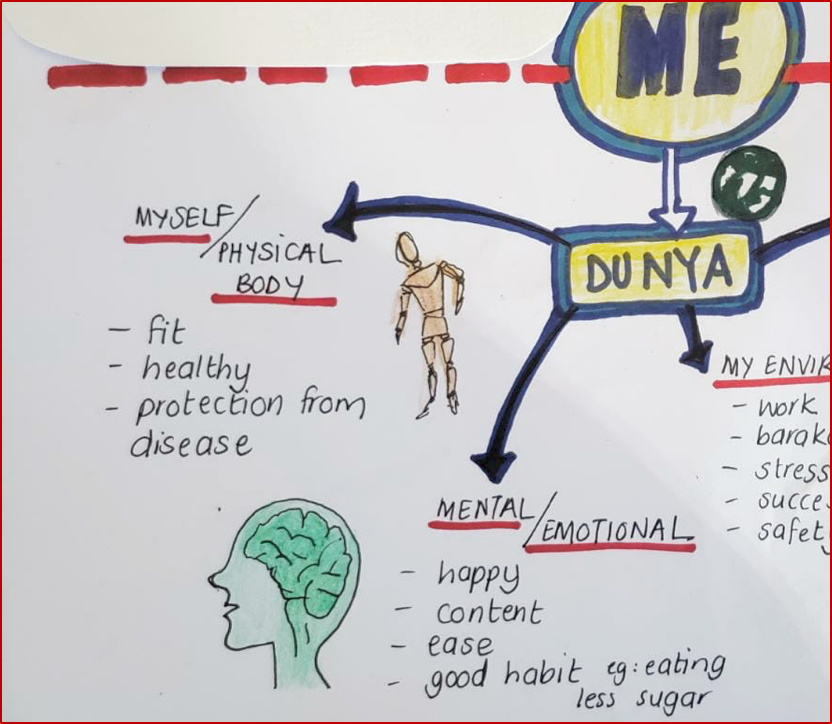
Under “dunya”, I expanded to all the aspects in my life that I could think of – such as for personal
(health, mental, emotional etc.) and then to people in my life (family, friends, ummah), my environment (work, safety, etc.). All the time, listing in each category everything I desired, for
example under health asking for a stronger body, or to meet my fitness goals. Under family I listed protection, their success and happiness. The beauty is that nothing is out of scope as I continued to list everything I wanted under each subheading, remembering that Allah is Most Powerful and Most Merciful and can grant as He wishes.

Benefits
The purpose of using this tool, over simply listing is that the subheadings or branches, just provide a logical structure to ensure everything is covered. The creative process provides a lovely flow as thoughts keep popping up, and I could easily capture it under each branch. It also brought to my consciousness some things in my life that I wanted changed, yet I was not explicitly making dua for it! So I could now add it my comprehensive dua list.
How to use it
So once complete, how do I use this dua mind map in practice?  I could now either use it as a reference point to look at when making dua, or I noticed that many things I uncovered during the creative process itself, now automatically came to mind each time I make dua which is a great outcome too. This map can also be used to prompt when making shukr (thanks to Allah) as part of dua and daily practice.
Finally, for the best results, I will consider the most effective times for supplication, and structure the dua according to the way we were taught by the Messenger of Allah (May peace be upon on him) by first thanking and praising Allah, and then emptying my heart to connect to Allah more deeply, using my new and improved comprehensive dua “list”.
In this way, I feel more present when I appeal to Allah through dua. I come from a place of being heartfelt, no longer absent mindedly making dua on autopilot. Rather I am fully conscious when I am asking for what I want from Almighty Allah- detailing to my hearts desire all the requests I can think of, for myself and my family, friends and indeed the world, Insha Allah.

Getting ready for Ramadan….Beyond stockpiling the freezer!

With two weeks to go before the start of Ramadan, I began some planning for this special month of mercy and forgiveness. Planning involving taking actions to be in the best space for maximum gains. As given are already self isolating, being home and with no distractions about going out – I feel we already have a headstart!

For many years, I found that I would consider myself ready for Ramadan once I had containers of savouries in the freezer, and a pantry filled with ingredients to make traditional desserts and dishes we especially enjoy in this month (sometimes to the extent of mandating it!)

But if the purpose of this month is to develop Allah Consciousness (“taqwa” in Arabic) as Allah says in the Quran (2:183)
“O you who believe fasting is prescribed to you as it was prescribed to those before you so that you can learn Taqwa” 
Taqwa includes Allah fearing, piety, and self restraining. An opportunity to turn things around. To become closer to Allah and to learn more about ourselves by learning more about Him. It involves doing lots of good to please Allah. And to exit the month with more than we entered – physically, spiritually, emotionally and mentally.

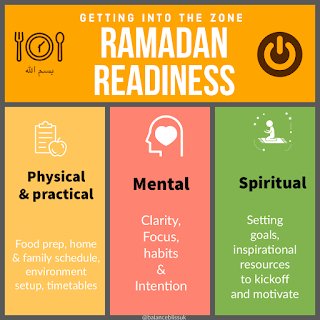
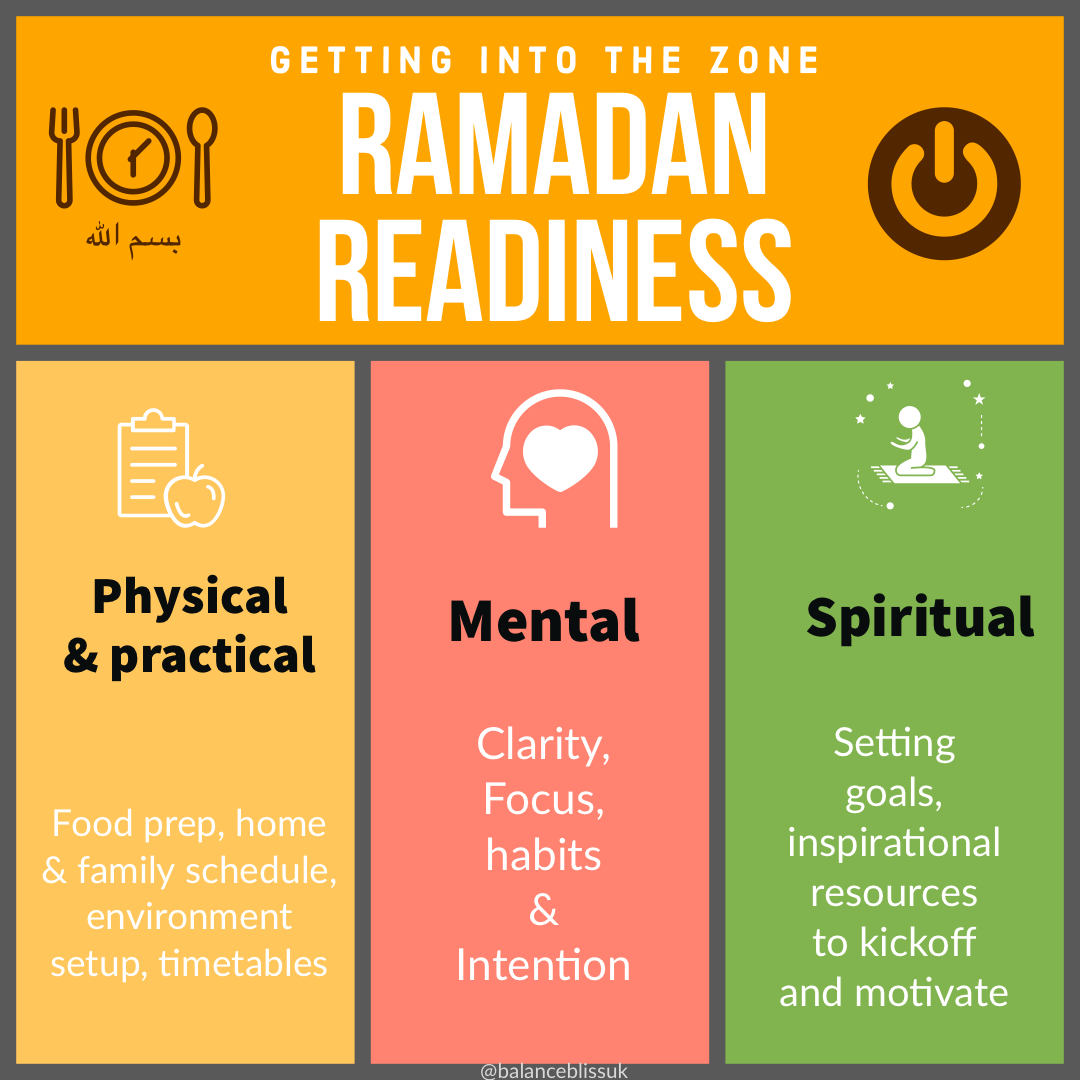
Which is why I drew up this chart – to remind myself about adopting a “holistic approach” to welcoming the Holy Month of Ramadan. Looking at all ACTIONS necessary to make the month as productive as possible. Here it is:

Holistic Approach to preparing for Ramadan. Please SHARE

Physical and Practical
This is usually my starting point. I would look at the key dates such as when do we start fasting and when is Eid and jot them into my calendar and diary. This would give me an indication of what else is going on around Ramadan (for example any appointments, meetings etc). It also gives me a good jolt into how much time is left for preparations before the start of the month! 

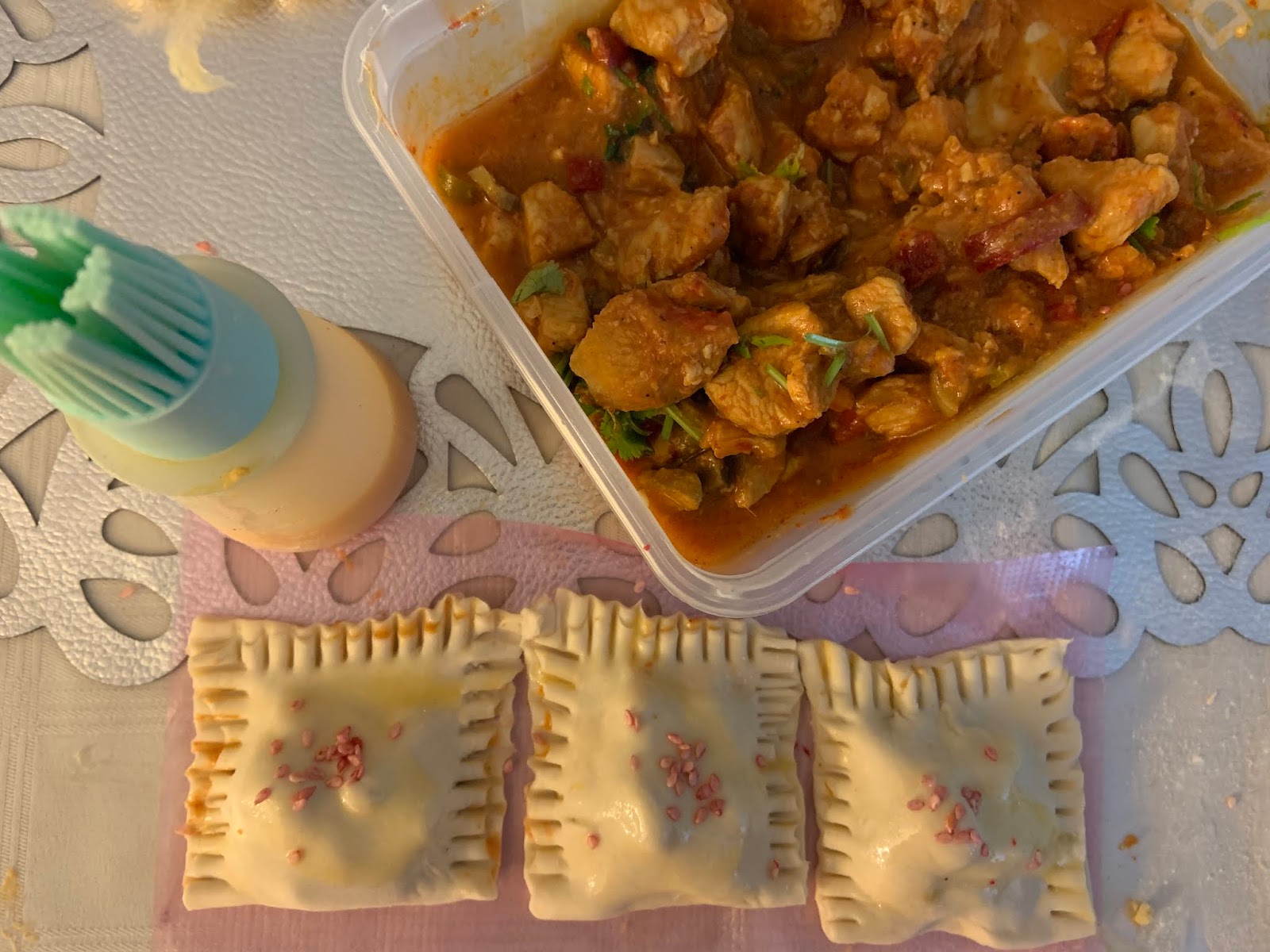
Next step is to plan what food preparation is needed. Without the convenience of abundant home made savouries and delicious chutney dips like we get in South Africa, if I want anything like what I am used to back home (such as samoosas or pies!) here in Istanbul, I better make it all myself (or do without it as I have in some years. Borek will have to do!). So this year where I could I used two evenings to do some preparations and I’m calling it a day.

A tip I learnt from my dear mother was to also do any Eid shopping such as clothes and gifts before Ramadan. That way you are not using precious Ramadan minutes running around with these activities! Also you can avoid the crowds. This year given the lockdown situation, I really don’t know what Eid will be like so holding on with any gift planning till things are more clear.

Lastly in this area is setting up the environment at home – putting up some exciting decorations, involving the kids in some crafts- all with the intention of creating a positive spirit and love for this beautiful month for the whole family. We have already started talking about Ramadan parties, so my little one is amped!

Mental Readiness
Setting a real focused intention immediately puts me in the right space. Reading up on the benefits of fasting, and listening to a few great speakers on the blessings of this month are great reminders about why I need to maximise on stacking up reward. 

If there are any habits I want to change, I might start working on them now, weeks before we start fasting. This year, I aim to give up on junk shows (at least!) on Netflix. I actually enjoy documentary style shows so I have already started switching to that instead. In Ramadan, I would aim to watch nothing at all. It always amazes me how I am able to detox in this way so easily, and occupy my time with extra prayer -or just rest.

Closer to the start of Ramadan I would begin my “fasting focus”, and do my best to clear my mind of all other peripherals – binge chats, binge Instagram scrolling, anything else taking me away from the sole purpose of this month – worshipping Allah and gaining closeness to Him.

This mental focus is so important as it sets the tone for the last pillar. We cannot pray in the sincerest way we are meant to if our mind is still cluttered with other things. I mentally put on hold anything extra that can wait for after the four weeks- so my mind has clarity and space.

Spiritual
The focus of the month will be on my soul- to uplift myself in a deep spiritual way Insha Allah. Usually this involves goals for completing recitation of the Quran, listening to tafseer, revising previously memorised surahs. I really enjoy understanding what I read in Quran so for this I have begun at least listening to (and often making notes though I do need to revise more so its more entrenched), the tafseer from leading scholars on the verses of Quran we read most often – for example starting with Surah Yaseen, Surah Kahf, and the last 20 surahs in Quran which are the ones I would read in my Salaatul Taraweeh every night. 

Other great resources I have come to love has been the daily 20 minute lectures that some scholars give live after Taraweeh salaah. My favourite being Ramadan Gems  and Ramadan Nightly Reminders (Mufti Menk). These are all available on demand on YouTube if you miss it live. It is centred around a theme such as Stories from Quran, or Stories about the Messengers, making it compelling listening to complete the full picture. Great learning.

So as you can see, if we start to break down all the aspects to consider in preparing for this month Insha Allah, there’s so much more beyond hanging up decor or stock piling the freezer!

How far are you with preparations for this beautiful month? And which aspects do you focus on?


Wishing you all a productive Ramadan, filled with barakah and blessings
Taskeen

Sit back and enjoy a response from ALLAH. ALLAH promises!

Greetings on this lovely day of Jumuah (Friday)


I have this thing with effort and reward. I practice it alot. Must be something I picked up growing up. Anyway, it serves me well as it works as motivation to keep me getting things done and working hard.


So it’s no wonder that this image shared on a family Whatsapp group hit home for me. It acted as a reminder for me to do my bit : all I need to do is these four things :
1. show gratitude
2. ask of Allah 
3. ask for forgiveness and 
4. constantly praise Allah
 
-and then sit back and enjoy a response from ALLAH Alone! 


There are some simple tasbeehs to read for each of these, so this is how I plan to implement.
 
Gratitude سبحان الله  (Subhanallah) Glory be to God
Ask of Allah:   لاَّ إِلَـهَ إِلاَّ أَنتَ سُبْحَـنَكَ إِنِّى كُنتُ مِنَ الظَّـلِمِينَ La Ilaha Illa Anta Subhanaka Inni Kuntu Minaz Zalimeen)  “…There are none worthy of worship besides You. Glorified are You. Surely I am from the wrongdoers.” (21:87)*
Forgiveness :  أستغفر الله‎ (Astaghfirullah)  I ask Allah forgiveness
Praise:  الحمد لله (Alhamdulillah) Praise be to Allah 
 
Maybe I can read them all every day, so maybe depending on the situation and my need I will increase recitation of a particular need. Either way, I am promised by my Lord a certain response from HIM if I do one of the following. WOW, that’s not just something, that’s everything!
 
Prayers and reminders I hope to heed, 
M4Life
 
*Dua of Prophet Yunus (May Peace be upon him), when he was swallowed by the whale and read this very powerful dua which I just love. Feel like it gets me out of any sticky situation, Alhamdulillah!

God-Given Super Powering with Purpose

Just to share what I learnt in my family halaqa last week.
We focused on the following Quranic Ayah (3:49):
وَرَسُولًا إِلَىٰ بَنِي إِسْرَائِيلَ أَنِّي قَدْ جِئْتُكُم بِآيَةٍ مِّن رَّبِّكُمْ ۖ أَنِّي أَخْلُقُ لَكُم مِّنَ الطِّينِ كَهَيْئَةِ الطَّيْرِ فَأَنفُخُ فِيهِ فَيَكُونُ طَيْرًا بِإِذْنِ اللَّهِ ۖ وَأُبْرِئُ الْأَكْمَهَ وَالْأَبْرَصَ وَأُحْيِي الْمَوْتَىٰ بِإِذْنِ اللَّهِ ۖ وَأُنَبِّئُكُم بِمَا تَأْكُلُونَ وَمَا تَدَّخِرُونَ فِي بُيُوتِكُمْ ۚ إِنَّ فِي ذَٰلِكَ لَآيَةً لَّكُمْ إِن كُنتُم مُّؤْمِنِينَ

And [make him] a messenger to the Children of Israel, [who will say], ‘Indeed I have come to you with a sign from your Lord in that I design for you from clay [that which is] like the form of a bird, then I breathe into it and it becomes a bird by permission of Allah . And I cure the blind and the leper, and I give life to the dead – by permission of Allah . And I inform you of what you eat and what you store in your houses. Indeed in that is a sign for you, if you are believers.

When Isa (AS) is talking to his people about the skill and power he was given, he keeps attributing it back to Allah (SWT) – “… by the permission of Allah.”  This is a reminder for us, when we get any recognition for the good or great things we do, that we need to first attribute it to Allah (SWT) who had given us the skills and ability to accomplish those things.
Secondly, regarding the power which Isa (AS) to return health to his followers, Moosa (AS) was also given powers around magic to show Pharaoh the evil of his ways.  What we can learn from the reasons they were given their respective gifts is that health and medicine was the topic of the day for Isa (AS) and magic was the major discussion topic in Musa’s (AS) time.  The powers they were given were relevant to their time and place and helped in fulfilling their respective missions.  So what we can learn from here is that we too, should utilise our skills in a relevant way to help others around us and spread the message of Islam.
Obviously one of the biggest things is to simply be better Muslims ourselves, but other than that… what is the most relevant topic today which people are interested in?  Technology, Media, Social Media, etc.   We have developed skills in these areas, including marketing and sharing info – this ayah serves as a reminder that I should use these tools / skills to spread the message. And it’s a reminder that any of these “super powers” I have been given, is from Allah – not my own great doing! This is humbling and grounding.
Super-powering with Purpose Insha Allah,
M4Life

Two Forms of Mercy…Two states in One

Salaams

So I listened to a talk recently by Ustaadh NAK (you know who I mean!) explaining the two Names of Allah Ar Rahman and Ar Rahim : two forms of mercy and I was so inspired. 

I also learnt that by listening to something more than once it really solidifies your understanding. Anyway here is my take on it based on what I heard:

Ar Rahman – ارحمان : Allah’s mercy and love is extreme, not permanent( this life),  happening right now ( eg hunger similar word pattern جوعان)  mercy that’s more immediate.

Ar Rahim – ارحيم – Allah’s mercy  that’s always there and you can count on it. Quality that doesn’t change. Not necessarily taking place right now- potential.

So what does it mean?

When you want Allah’s mercy in a time of need, you need it immediately – and intensely! Then you appeal to His quality of Ar Rahman. Not thinking of the future or the potential of mercy right now. But as a human we need instant meeting of needs.

Once it’s met, you now can turn to his quality of Ar Raheem knowing he will always have Mercy should you need to call upon it in the future.
Subhanallah!

Only in Allah the Most Powerful can two forms exist in one – amazing.

May Allah grant us understanding and MERCY

Aameen

🙂
Praying for His Mercy,
M4Life