What helps me making sense of tragedy – developing through difficulty

I’ve been grappling with trying to process the effects of the recent earthquakes in Turkey and Syria.

Such a huge tragedy that has affected millions of lives – it’s alot to get your head around. Some of us are not directly impacted, but living in this country, we are impacted none the less.

My starting point in processing, is to understand it in my own mind. To do that, I consider the context, impact, and whats incredibly insightful has been shining an islamic lens on it to see it from that angle.

I don’t have a clear picture to share as yet – but these resources have been very beneficial to me in providing me some perspective and to organise my thoughts. I would like to share in the hopes that I also inspires you and gives you deeper understanding too.

1. Pop-Up Healing Circle for the Earthquake in Turkey, Syria, and the surrounding regions from Maristan

This presentation had mental health professionals, Drs and community leaders with humanitarian work experience unpack what trauma is faced after crisis, for both those affected directly or facing secondary effects. It helped me give a name to the feelings I was having.

2. Understanding decree and command of Allah by Imam Shuaib Webb
This was a live zoom meeting – but he summarises a key point in this clip on his Instagram page. I felt validated, comforted by his words and he gave alot to think about. Favourite quote:

“Your stability for your kids will calm their instability in face of the earthquake situation”

3. Why does Allah allows earthquakes and suffering by Imam Omar Suleiman

This short talk gave me so much hope and acceptance. I was reminded how as Muslims we know that our pain has a purpose. Everything we go through is to teach us something and is part of something bigger we are working for. My favourite point was about how as people of faith, we have the golden gift of “perspective”. So lets use it to work through this tragedy.

Do you have any great links that have inspired you through adversity? How have you been processing the recent events, what helps you to get through difficult times?

How I improved my duas to Allah with one easy tool

As part of my preparations for Ramadan this year, I decided to spend some time focusing on my dua, and defining what it is I would be asking of Allah during this special month. I realized that whilst dua is a daily practice, preceded by my every salaah, I have not given it enough meaningful attention to benefit from the value I could otherwise gain from it.

Allah says in the Quran (Chapter 40, Verse 60): “Call upon me; I will respond to you.”

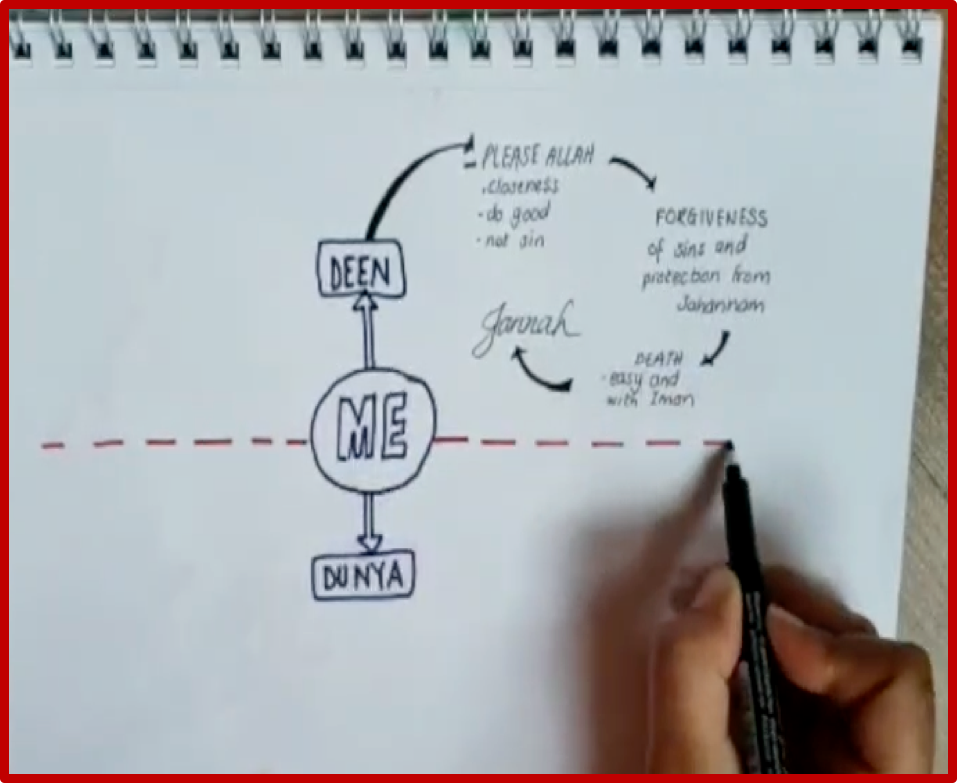
I became aware that I have not been clear and specific in my appeal to Allah, often just quickly rattling off some previously thought of requests without giving it conscious thought. To expect results, I need to define exactly what I wanted from Allah, in all aspects of my life. This way I can feel sincerer and connected to Allah with my requests. So I sat down and brainstormed all the many things I wanted for myself- and my family by using an awesome tool called “Mind Maps.”
Artist: AJacub786
This takes me back to my school and university days where I would use this technique for studying, to categorise information when there is a lot to work with. Mind Maps are a creative way to visually represent ideas or lists that we have in our minds. It can help us to structure our thinking to give it purpose and meaning. We start with one idea and branch off to many others, thereby capturing all the things we want under each topic.

How to complete the Dua Mind Map
So for example, when structuring my dua request, I started with myself: “Me” in the image above, and then separated into two main areas: Deen (Hereafter) and Dunya (This World). Under “deen” I listed a few headings such as pleasing Allah, forgiveness and our ultimate goal – attaining jannah. You could list all the steps we need to take to get to jannah.


This World
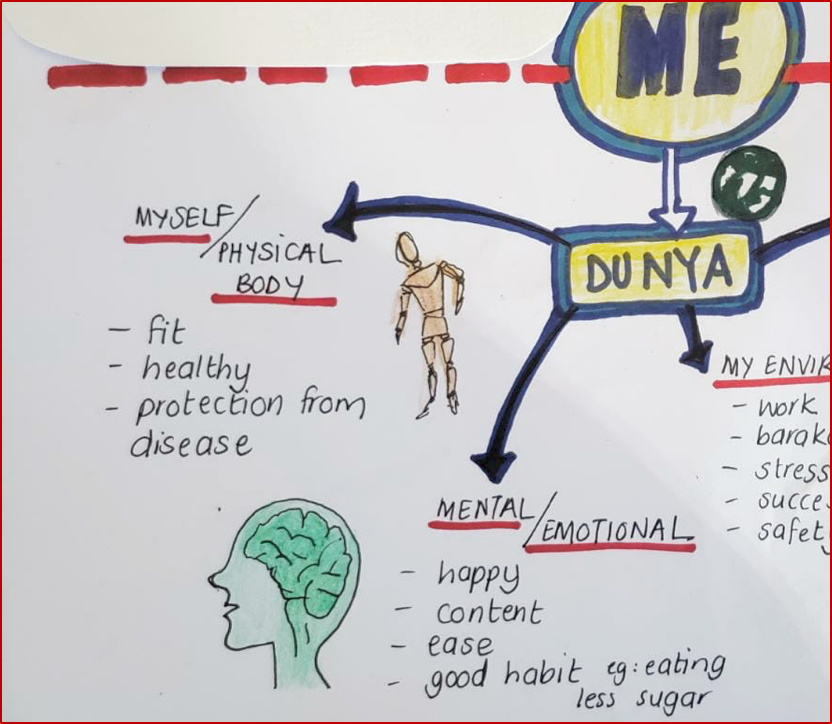
Under “dunya”, I expanded to all the aspects in my life that I could think of – such as for personal
(health, mental, emotional etc.) and then to people in my life (family, friends, ummah), my environment (work, safety, etc.). All the time, listing in each category everything I desired, for
example under health asking for a stronger body, or to meet my fitness goals. Under family I listed protection, their success and happiness. The beauty is that nothing is out of scope as I continued to list everything I wanted under each subheading, remembering that Allah is Most Powerful and Most Merciful and can grant as He wishes.

Benefits
The purpose of using this tool, over simply listing is that the subheadings or branches, just provide a logical structure to ensure everything is covered. The creative process provides a lovely flow as thoughts keep popping up, and I could easily capture it under each branch. It also brought to my consciousness some things in my life that I wanted changed, yet I was not explicitly making dua for it! So I could now add it my comprehensive dua list.
How to use it
So once complete, how do I use this dua mind map in practice?  I could now either use it as a reference point to look at when making dua, or I noticed that many things I uncovered during the creative process itself, now automatically came to mind each time I make dua which is a great outcome too. This map can also be used to prompt when making shukr (thanks to Allah) as part of dua and daily practice.
Finally, for the best results, I will consider the most effective times for supplication, and structure the dua according to the way we were taught by the Messenger of Allah (May peace be upon on him) by first thanking and praising Allah, and then emptying my heart to connect to Allah more deeply, using my new and improved comprehensive dua “list”.
In this way, I feel more present when I appeal to Allah through dua. I come from a place of being heartfelt, no longer absent mindedly making dua on autopilot. Rather I am fully conscious when I am asking for what I want from Almighty Allah- detailing to my hearts desire all the requests I can think of, for myself and my family, friends and indeed the world, Insha Allah.

Ramadan Activities – awesome links to save you time!

I have been scouring the net on your behalf, to find amazing resources for activities suitable for my 3 year old.

To save you time, here are some brilliant ideas I found with really useful and with beautiful content:

1. Talking to Allah with Thank You, Sorry, Please: Parenthood Muslim Style

2. Crafts and Printables from Happiness is Homemade

3. The Greeting of Peace -ebook from Muslim Central

4. Playfully app – great games to play with your baby up to toddler. Love it, practical and evidence based.

Save this post to your Bookmarks tab on your browser so you always have it on hand!

Productive Muslim Mom

Towards Perfecting Prayer : how the nations before us went wrong

Listening to the tafseer of Surah Maryam, I was really touched by the lessons taught regarding the importance of salaah (prayer).
From Salaam Studios, Shaykh Jangda in a month long Intensive course on Surah Maryam on YouTube eloquently explained how the really bad nations before us that were involved in the worst of sins and evil deeds. It all started with them being neglectful of the prayer. Some scholars interpret being neglectful as being reducing the quality of prayer by rushing, or delaying prayer or just not going to the Musjid at all. Whichever way it was, it was surely all downhill from there. 
Why is that? Well he explains, if you can’t be good to Allah ( ie  fulfill His rights), then how can fulfill anyone else’s?
It goes like this :
When you choose not to pray your salaah, you are in effect just looking after yourself. So then you stop feeling like helping other people as you are self absorbed with your own desires. That leads on to you interacting with bad people. Then, when at times you  feel a bit guilty, you start seeing the Day of Judgement- not something believable as a reality when you are so busy with having a good time here and now. This is how you can become totally distracted and on the wrong path.
We hear the stories about the people of the past that were destroyed… And it seems to us so distant from us – but are we not also guilty of neglecting the prayers to some extent… So in reality how close are we to becoming that way and how important is it that we halt our negligence of prayer right away!

 Related in Muslim : A man came to the Prophet (saws) and said O Prophet of Allah (saws),what is the act or deed most loved by Allah?The Prophet (saws) replied:  To pray ones prayers on time. The man asked further: What (deed or act most loved by Allah) next? The Prophet (saws) replied: Obedience to ones parents.The man asked further: What (deed or act most loved by Allah) next?The Prophet (saws) replied: Jihaad in the Way of Allah.

Some Very Practical Steps I have been inspired to take to perfect the prayer, as suggested from Shaykh: 
 1. Pray salaah when the time of the prayer starts  -It’s a really simple thought, but I found if I do this, I feel more relaxed during and after the prayer. I now live in a country where I am fortunate to hear the adhaan live, giving me every chance possible to do this. Knowing it’s a teaching from the sunnah is a great boost as well.
2. If the above is not possible (due to work or another valid  reason), then fix a personal specific time of prayer (within reason of course!), so in your schedule you know that at 2pm everyday you will pray Zuhr, for instance. Then you can work your day around this. Certainly in Europe during winter this became a must as the days were so short, and with an hour or so between the day’s prayers I had to set specific times to pray and not miss the time!
3. Work our salaah! When Nabi Muhammad (may peace be upon him), was sad when there was a pause between revelation, he was advised to turn to prayer as a means of still connecting to Allah. We can do the same. All we have to do is turn salaah from being a ritual to it being functional – a source of comfort, a way to connect and speak to Allah. And we know that through reciting Surah Faatiha,  Allah responds to us. How much more meaningful can the prayer now be for us?
Towards perfecting prayers Insha Allah,
M4life

When wearing your hijab is like wearing your knickers and socks….

Slms,

I’m sure you want to know what is going on with my title, so I’m going to share a story with you that explains where this phrase comes from!

I was chatting to my friend who recently Alhamdulillah decided to start wearing hijab. I’m so proud of her. She works in corporate and travels significantly so I’m sure its a quite a challenge and so I’m so pleased for her and make dua Allah makes it easy for her, and rewards her for sincerity in trying to please Him.

So she was saying how its tricky at work…people seem to be looking at her weirdly…and shes so aware of it all. As a regular hijabi myself, also in corporate for about 10 years, travelling in Europe and working with multinationals from Australia to Brazil,  Alhamdulillah, this is the advice I gave to her which I hope makes sense to you and inspires you to either consider starting to wear hijab or if you are, to continue and NEVER take it off…for as I say “Keep at it till wearing your hijab is like wearing your knickers and socks!”

  • Don’t send out “uncomfy” (sic) vibes : Don’t be overly conscious of wearing hijab as you will no doubt send out signals to others if you are feeling uncomfortable. This will make you feel more out of place for no reason as in reality most people wont even notice anything!
  • Take the First Step Forward : I received feedback once on a leadership course (in a very honesty sharing session!) that people wonder whether how to approach hijabis – as in will you talk to men, how will you respond etc. So as a hijabi in the workplace, perhaps we need to take the first step to talk to people, show our personality and that its OK, we don’t bite or scare, just regular people also interested in shopping and makeup (in a halal way of course!).
  • Show them you’re Still the Same : If you have recently started to wear hijab, just continue as normal showing them you haven’t changed who you are, talk the way you would and do your thing. Their main concern would be whether they need to be in any other way with you so just keep being as you are and things will fall into place naturally Inshallah.
Keep at it sisters, you know you have turned the corner when you cannot leave the house without it on, and when wearing your hijab is like wearing your knickers and socks – you can never forget it and cant do without it!! 
May Allah make it easy for us all.
Me at my previous workplace 🙂
Do you have any other tips to share with other hijabi muslimahs? I have so many stories to share about my hijab adventures, Inshallah with other posts to come! 
M4Life

Submission

Slms
You know what, do we truly know what submission is? Im not sure we understand what it means truly? I certainly found it difficult to do..I really really want something (this job), but then my dua to Allah is that I completely submit to you Allah and only if this job is good for me, for my Islam and my future, then grant it to me IA. Otherwise, turn it away. I will do the most that I can do and leave the rest to Allah..
Easier said than done!!
Can we truly let go and leave it to Allah? whats the balance between wanting something so bad and actually just leaving to Allah to judge whats best? we are so limited in our knowlegdge,only Allah sees the bigger picture. We have to trust in that. Truly trust and let go
Inshallah, thats what I plan on doing right now.
Oh Allah, in my limited knowledge this is my dream job and I really want it. But Allah what I want more is YOUR guidance and intervention. So please if this job is right for me and will bring me closer to my goals and to you, then please make it possible for me to attain easily. If not, please turn it away. Please grant me sabr to deal with the consequence and to accept YOUR plan. Aameen
Striving towards a better life,
Taskeen
M4life

Covering my Hair- interesting reading

1) When I Covered My Head, I Opened My Mind

As a non-Muslim living in Western society, the idea of modesty was not exactly foremost in my mind. Like all other women of my generation and mind-set, I thought such ideas were antiquated and excessive.

I felt pity for the poor Muslim woman who had to “wear all that junk,” or “walk around in bed – sheets” as I used to call it I was a modern woman, educated and liberated. Little did I know the awful truth. I was more oppressed than any Muslim woman in the most culturally oppressive village in the Muslim world. I was oppressed not by an inability to choose my clothing or to choose my life-style, I was oppressed by an inability to see my society for what it really was. I was oppressed by the idea that a woman’s beauty was public, and that lustful admiration was equal to respect. It was when Allah guided me to Islam, and I put on the hijab, that I was finally able to step out of the society in which I lived and see it for what it really is. I could see how the highest paid women were those who exposed themselves to public display, like actresses, models and even strip-tease dancers. I was able to see that the relationship between men and women was unfairly stacked in the man’s direction. I knew I used o dress to attract men. I tried to fool myself by saying

I did it to please myself, but the painful reality was that what pleased me was when I was admired by a man I considered attractive. I now know that there is no way for a person to know that he is dirty if he has never been clean. Similarly, I was not able to see that I was oppressed until I stepped out of the darkness of this oppressive society into the light of Islam. With that light shined on the truth, I was finally able to see the shadows that had been so obscured by my Western philosophies. It is not oppression to protect yourself and society; it is oppression to voluntarily throw yourself into the quagmire while

denying it is dirty. I am grateful to Allah that He allowed me to recognize that when I covered my head, I was taking away from people any means for judging me other than my mind, my soul and my heart. When I covered my head, I took away the incentive for exploitation based on beauty. When I covered my head, I made people respect me because they saw that I respected myself, and when I covered my head, I finally opened my mind to the truth.

2) Teach, Don’t Preach

One of the factors which attracted me to this great deen of ours was the fact that so much of it can be understood based on logic and reason. that is why I feel that many Muslims parents do themselves a great disservice by not explaining more to their children. The old, “Because I say so…”, or because you are an Arab, Pakistani, Somali, (fill in your cultural preference)…” never has worked and never will work. Human beings have a natural desire to understand what they do  and why they do it, that is why Islam is such a great religion, because it satisfies all of our basic intellectual and emotional needs; it does this simply because it is the truth, and the truth is always easy to understand and defend. When we teach our children, we should use the same sound reasoning and logic that we use to convince ourselves that a particular deed is beneficial. Thus, as we accept it, so, inshallah, will they because it will be understandable. Of course we preface every instruction with the understanding that we do

what we do to please Allah and Allah only, even if we can not understand it, but alhamdulillah we have a means to understand the majority of what we do and avoid as Muslims. For instance, we know that we don’t eat pork because Allah commands us in the Glorious Quraan to avoid it. Then, we know that our beloved Prophet (Sal Allahu alayhi wa salam) commanded us to avoid it. We need to tell this to our kids,

and as they grow and increase in their understanding we need to  show it to them. This teaches them some important lessons. It shows them Allah’s commands; it shows them the importance of the

Prophet’s (Sal Allahu alayhi wa salam) commands, and it shows them the basics of researching into the deen. Then, once we set this as our base, we need to explain to them the wisdom of this command.

Talk about the diseases associated with eating pork. Discuss the unsanitary living/eating habits of this animal. Essentially, teach them those things which help you to avoid this sin. Teach them to use their faith and their mind in unison as tools towards achieving the ultimate goal of reaching Jannah.

Shariffa Carlo

How Allah blessed me this month

slms
Allah blesses us in different ways..My latest blessing is my new work environment
 
Allah has given me a complete revolution in my work evironment, Alhamdulliah. From a very difficult team and management where I was downright miserable to say the least, I feel like I have a new leash on life now!
 
I have this wonderful manager who is so calm, understanding,cool , friendly, funny..etc etc, a senior manager who is non judgemnetal, non imposing, fresh, down to earth and has an absoultely brilliant mind and knows whats potting, Im part of  a bigger team who is playful, friendly, sooo easy to get along with and who completely gets me! we have so much fun at work
Alhamdulillah, its sooo wonderful, I laugh so much at work!
 
Allah had to show me the worst ever to appreciate this wonderful space.If I hadnt been through hell then I wouldnt keep thanking Him so much for this happiness 🙂
 
This is how Allah has blessed me this month
 
🙂
M4life

Affirmations- working!

Slms
 
Im trying this new thing …saying affirmations to myself all the time even if I dont quite feel like I mean it just yet, it will come in time
 
So its gotta be present tense, positive, and continuous
 
like this morning I kept saying ” This is a good day”, “All my work is getting done”, “Everything that I do will have a magical sparkle to it”
 
 
Alhamdulillah, in 2 hours I did more work that I would ordinarily do in maybe 1 day!! lol
 
Allah is with me 🙂
M4life

A nice saying…

Slms
Im dying to share this …
 
“Dont let yesterdays negative thoughts affect tomorrows experiences”
Louise L Hay
 
Jummuah Mubarak
🙂
M4life